



Publised On:Nov 02, 2026
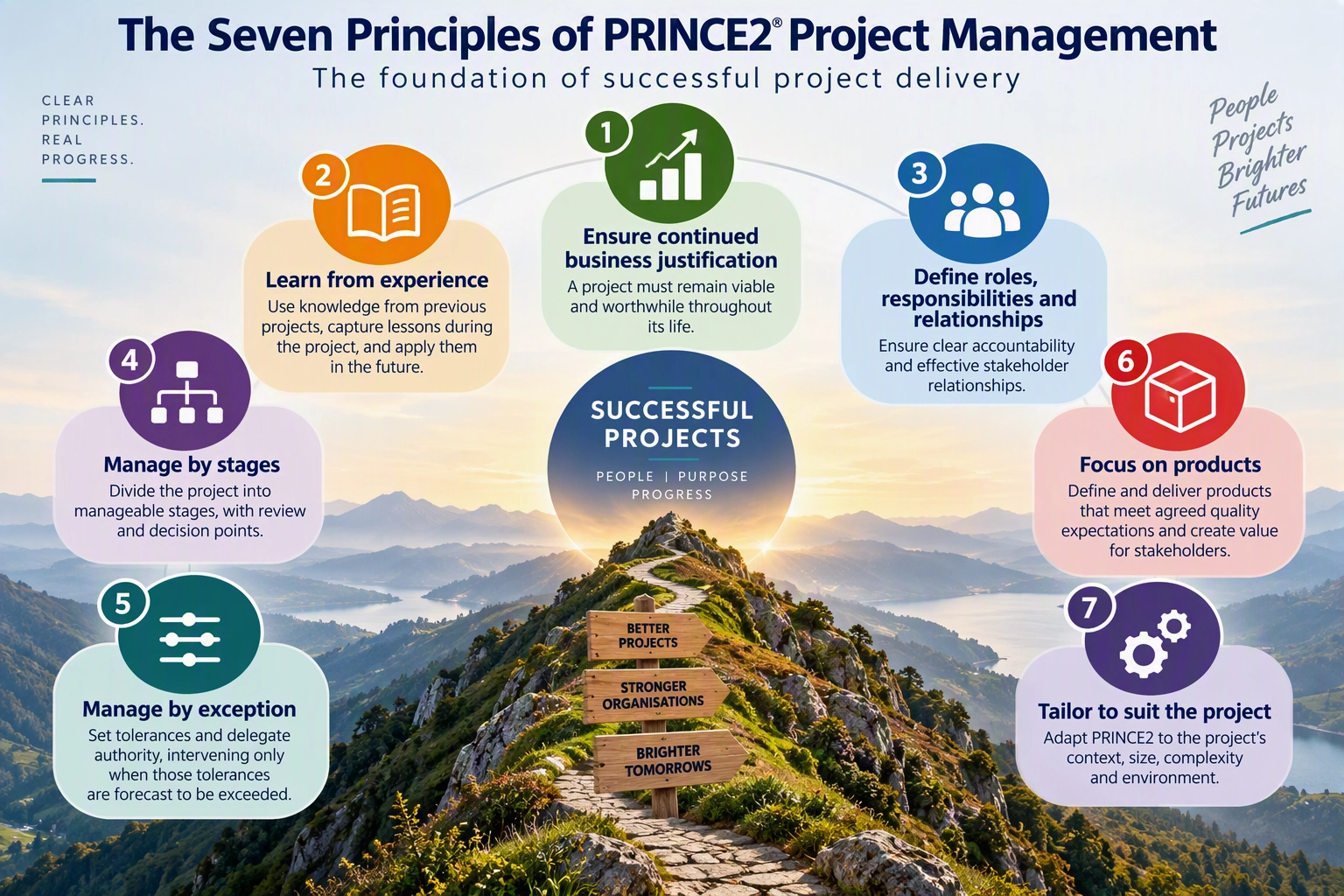
Every successful project needs more than a plan, a schedule, and a budget. It needs a set of guiding principles that help decision-makers navigate uncertainty, maintain control, and ensure that the effort invested ultimately delivers value. This is exactly what the seven principles of PRINCE2 Project Management provide.
PRINCE2 Project Management defines its principles as the guiding obligations that determine whether a project is genuinely being managed using the method. The framework states that all seven principles must be applied; otherwise, the project cannot truly be considered a PRINCE2 Project Management project.
What makes these principles powerful is their universality. Whether the project involves constructing a shopping centre, launching a cybersecurity product, delivering a public awareness campaign, or implementing a new business system, the principles remain relevant. They provide a flexible framework that supports projects of all sizes, industries, and delivery approaches.
This article explores each principle in depth and explains why they continue to be central to successful project delivery.
The first and arguably most important PRINCE2 Project Management principle is that a project must have a valid reason for existing, and that reason must remain valid throughout the project's life. PRINCE2 Project Management emphasizes that a project should only continue while the expected benefits outweigh the costs, risks, and effort involved.
Many organizations have experienced projects that seemed like good ideas initially but gradually lost relevance as circumstances changed. Market conditions evolve, technologies become outdated, strategic priorities shift, and assumptions prove inaccurate. Without ongoing review, teams can spend months or even years delivering something that no longer creates value.
PRINCE2 Project Management addresses this problem through the business case. The business case is not a document that is created once and forgotten. Instead, it acts as a living justification for the project and is reviewed regularly throughout the project lifecycle.
This principle encourages leaders to continuously ask:
One of the most mature decisions a project board can make is to stop a project that no longer makes business sense. PRINCE2 Project Management views this not as failure, but as responsible stewardship of organizational resources.
In reality, this principle keeps projects aligned with strategic objectives and prevents organizations from continuing initiatives simply because significant time or money has already been spent.
Every project generates lessons. The problem is that many organizations repeatedly make the same mistakes because those lessons are never captured, shared, or applied.
PRINCE2 Project Management treats learning as a continuous activity rather than a one-time exercise. Project teams are expected to actively seek lessons from previous projects, apply them during delivery, and capture new insights for future use.
Learning occurs at three key points:
Teams review lessons from previous projects and identify practices that can improve current performance.
Lessons are captured continuously. Teams review successes and failures, make adjustments, and improve performance while the project is still underway.
Insights are documented and shared to benefit future projects.
This principle reflects an important reality: every project contains unique elements. No project manager has encountered every challenge before. By drawing on collective experience, projects become more predictable and resilient.
The principle also recognizes that lessons are only valuable when acted upon. Simply recording observations without changing behaviour creates "lessons identified" rather than "lessons learned." PRINCE2 Project Management expects organizations to move beyond documentation and convert knowledge into improved practices.
Projects bring together people from different departments, organizations, and disciplines. Without clear accountability, confusion quickly emerges.
One of the main causes of project failure is uncertainty about who makes decisions, who owns specific outcomes, and who should be consulted. PRINCE2 Project Management addresses this through clearly defined roles and responsibilities.
The method requires representation of three key stakeholder interests:
These perspectives are represented through the project board structure, ensuring that strategic, operational, and delivery considerations are balanced throughout the project.
However, PRINCE2 Project Management goes beyond organizational charts. The principle also emphasizes relationships. Stakeholders influence projects in countless ways, and successful delivery depends on effective communication, collaboration, and trust.
When everyone understands:
projects become easier to manage and conflicts become easier to resolve.
In today's increasingly complex and cross-functional environments, clarity of responsibility remains one of the most valuable project management disciplines.
PRINCE2 Project Management recognizes that no one can predict everything at the start of a project. Instead of planning every detail upfront and hoping for the best, the method divides projects into manageable stages.
A stage is a section of the project managed as a distinct unit. Each stage concludes with a formal review where progress, risks, performance, and business justification are assessed before proceeding.
This principle delivers several important benefits:
Smaller chunks of work are easier to monitor and manage.
Project boards receive regular opportunities to review progress and make informed decisions.
Plans can be adjusted between stages as circumstances change.
Organizations avoid committing all resources upfront before confirming continued viability.
The principle aligns particularly well with modern delivery approaches. Whether a project uses traditional waterfall methods, agile techniques, or a hybrid model, stages provide natural decision points that support governance and oversight.
Rather than viewing a project as one long journey, PRINCE2 Project Management treats it as a series of controlled steps that collectively lead toward the desired outcome.
One of PRINCE2 Project Management's most practical principles is managing by exception.
Many organizations waste valuable leadership time because senior managers become involved in everyday project decisions. PRINCE2 Project Management seeks to avoid this through the use of tolerances.
Tolerances define the acceptable variation around agreed targets for:
As long as performance remains within agreed limits, the project manager has the authority to manage without escalation. Only when performance is forecast to exceed a tolerance does an exception arise and require higher-level intervention.
This approach creates several advantages:
The principle reflects a modern leadership philosophy. Rather than monitoring every detail, leaders set boundaries, establish expectations, and intervene only when necessary.
By giving teams clear limits and appropriate authority, organizations can improve both efficiency and accountability.
Projects exist to deliver outcomes, not activities.
Yet many teams fall into the trap of measuring success through effort rather than results. Meetings are held, tasks are completed, and budgets are consumed, but stakeholders remain uncertain about what is actually being delivered.
PRINCE2 Project Management addresses this through a strong focus on products. A product is any tangible or intangible output that can be defined, created, and tested.
The method encourages teams to define products before planning the work needed to create them. This product-based approach provides clarity about:
By concentrating on products, projects can:
This principle is particularly valuable because stakeholders generally care about what the project produces, not how much effort was invested.
Successful projects are judged by their outputs and outcomes, not by the number of activities completed. PRINCE2 Project Management keeps this reality at the centre of project management.
Perhaps the most misunderstood aspect of PRINCE2 Project Management is the belief that it is rigid or bureaucratic.
In reality, one of its core principles is tailoring. PRINCE2 Project Management expects every project to adapt the method to its unique circumstances.
Projects differ in:
Applying the exact same level of governance to every project would be inefficient.
A simple three-month internal improvement initiative requires a different level of control compared with a multi-million-pound infrastructure programme. PRINCE2 Project Management recognizes this reality and provides flexibility while preserving the integrity of its principles.
Tailoring may involve:
The goal is not to follow PRINCE2 Project Management mechanically. The goal is to apply it intelligently.
This principle ensures the method remains practical and relevant regardless of project type or organizational maturity.
The seven PRINCE2 Project Management principles form the foundation of one of the world's most widely used project management methods. Together, they provide a balanced framework that combines governance, flexibility, accountability, and value delivery.
The principles encourage project teams to:
Although project management tools, technologies, and delivery approaches continue to evolve, these principles remain timeless. They address the fundamental challenges that every project faces: uncertainty, complexity, change, and the need to deliver value.
Projects that consistently apply these principles are far better positioned to achieve successful outcomes, satisfy stakeholders, and realize the benefits that justified their creation in the first place.