


Publised On:Nov 02, 2026
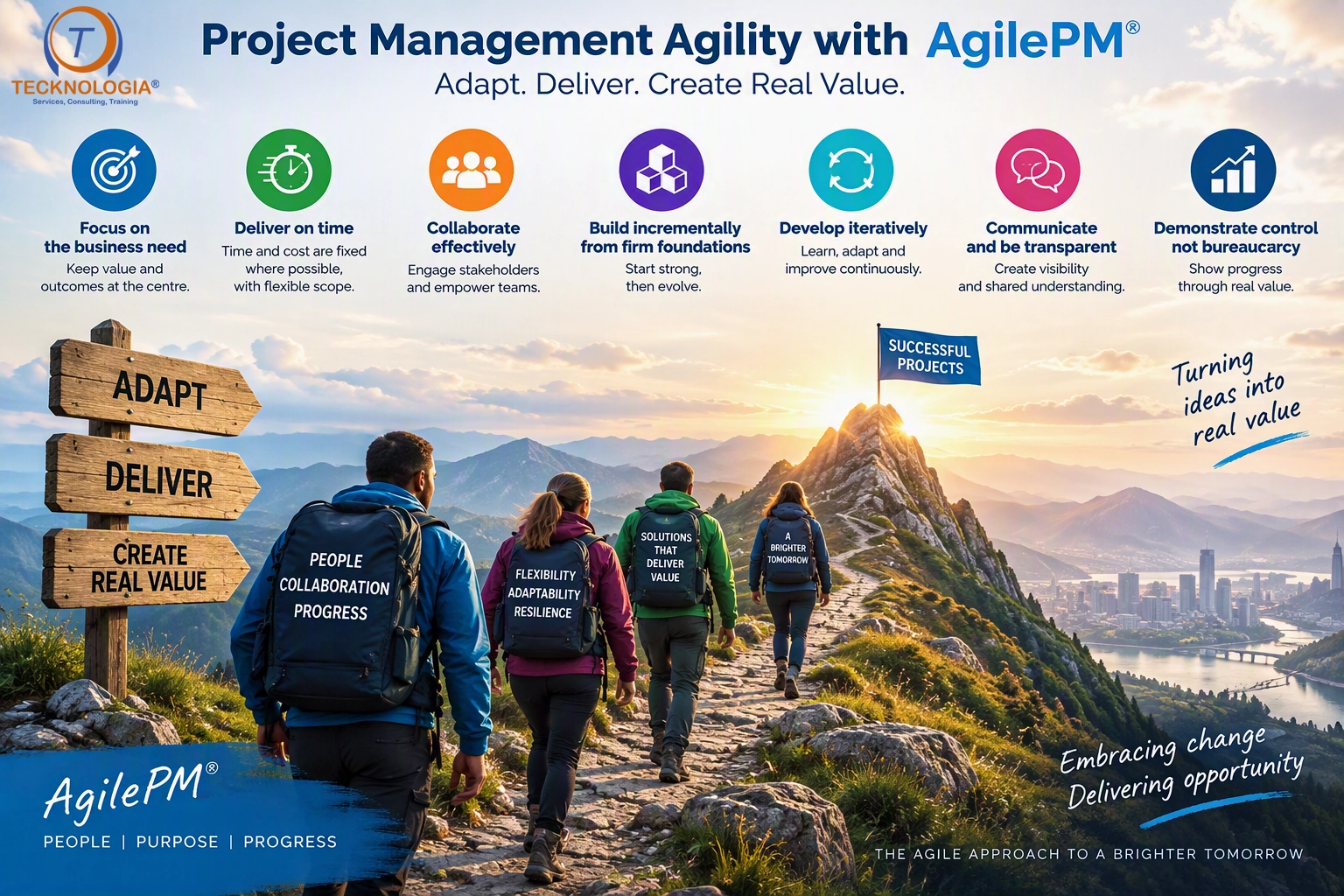
Modern projects operate in an environment that is constantly changing. Customer expectations evolve rapidly, technology advances at an unprecedented pace, and organizations must respond to shifting market conditions, regulations, and competitive pressures. In such an environment, the traditional project management assumption that everything can be planned upfront and managed through detailed control increasingly becomes unrealistic.
This is where Project Management Agility becomes essential.
According to the AgilePM framework, agility is not simply about delivering faster. It is about creating the ability to think, assess, adapt, and respond effectively to change while continuing to deliver value. Agile project management recognizes that uncertainty is not an exception to be controlled; it is the natural state of many modern projects.
AgilePM was developed specifically to help organizations navigate this reality. Combining the governance and structure required for successful project delivery with the flexibility and adaptability of agile ways of working, AgilePM enables organizations to remain responsive without sacrificing control.
This article explores what project management agility means, why it matters, and how the AgilePM framework supports organizations in delivering successful outcomes in an increasingly complex world.
Agility is often misunderstood as simply "working quickly." In reality, agility is the ability to adapt effectively while maintaining a clear focus on achieving desired outcomes.
The AgilePM reference book explains that today's organizations operate in a VUCA environment characterized by:
In such environments, long-term predictions become increasingly unreliable. Requirements evolve, stakeholder priorities shift, and new information emerges continuously throughout a project's lifecycle.
Traditional project management methods often assume stability. They rely on detailed upfront analysis, comprehensive planning, and strict change control processes. While this approach can still be effective in stable and predictable situations, it becomes increasingly difficult to manage when change is frequent and unavoidable.
Project management agility recognizes a simple truth:
The further into the future we plan in detail, the more likely those plans are to become inaccurate.
Agile organizations therefore focus on creating the ability to inspect, learn, adapt, and respond as new information becomes available.
Historically, many projects failed because they attempted to define every requirement at the beginning and then followed a rigid sequence of activities to deliver solutions.
The AgilePM reference highlights several common challenges associated with traditional approaches:
These challenges become even more severe in fast-moving environments where customer needs continue to evolve throughout the project.
Project agility provides an alternative. Instead of attempting to eliminate uncertainty, AgilePM accepts uncertainty as normal and provides mechanisms to manage it effectively.
Organizations that embrace agile project management gain several advantages:
AgilePM identifies several characteristics that distinguish agile projects from traditional projects.
One of the core ideas behind project agility is delaying detailed decisions until the point where sufficient information becomes available.
Rather than making detailed design and planning decisions months in advance, AgilePM encourages teams to:
This approach reduces wasted effort, minimizes rework, and improves decision quality because decisions are based on the most current knowledge available.
AgilePM promotes iterative development where work evolves through short cycles of learning and improvement.
Each iteration includes:
This creates frequent opportunities to challenge assumptions, validate requirements, and improve the solution based on actual stakeholder feedback.
Rather than assuming the team knows everything upfront, agile projects allow the best solution to emerge gradually through collaboration and learning.
Traditional projects often deliver value only at the end.
Agile projects deliver value incrementally.
Instead of waiting months or years for the final solution, stakeholders receive usable outputs throughout the project lifecycle.
Incremental delivery creates several benefits:
The organization begins benefiting from the project much earlier, while project teams gain valuable insights that improve future deliveries.
At the heart of AgilePM is a simple philosophy:
"Best value emerges when projects are aligned to clear goals, deliver frequently and involve the collaboration of motivated and empowered people."
This philosophy places people, collaboration, and value creation at the centre of project delivery.
Successful agile projects rely on:
The framework does not view agility as the absence of structure. Instead, it combines adaptive delivery with governance, accountability, and strategic alignment.
AgilePM supports agility through a combination of principles, practices, roles, governance mechanisms, and delivery techniques.
Every project decision should align with business goals and desired value.
AgilePM ensures this through:
This keeps teams focused on delivering outcomes rather than simply completing activities.
AgilePM recognizes that timing often determines value.
A solution delivered too late may lose its relevance or market advantage.
To address this, AgilePM fixes time and cost wherever possible while allowing flexibility in scope.
This approach enables organizations to maintain commitments while adapting to changing conditions.
Project agility depends heavily on effective collaboration.
AgilePM promotes collaboration through:
The framework emphasizes that teams achieve better results when they work together toward shared goals instead of operating in silos.
AgilePM balances flexibility with structure.
Before delivery begins, teams establish:
Once these foundations exist, teams can evolve the solution safely through incremental delivery.
This prevents chaos while preserving agility.
The framework embraces continuous evolution.
AgilePM encourages:
Every iteration provides an opportunity to learn and refine the emerging solution.
Communication failures remain one of the leading causes of project failure.
AgilePM directly addresses this through:
Transparency ensures that stakeholders always understand project status, challenges, and progress.
One of the biggest misconceptions about agile projects is that they lack governance.
In reality, AgilePM places significant emphasis on control.
However, control is demonstrated through:
Instead of relying on bureaucracy and reporting, AgilePM creates confidence through evidence of progress and delivered value.
AgilePM does not replace Scrum.
Instead, it complements Scrum.
Scrum provides an excellent framework for team-level product development through:
AgilePM extends those capabilities into the broader project environment.
It provides:
This combination enables organizations to achieve agility at both delivery-team level and project level.
One of AgilePM's most powerful agility mechanisms is MoSCoW Prioritization.
Requirements are categorized as:
This creates built-in flexibility.
When circumstances change, lower-priority features can be adjusted without compromising delivery commitments.
Rather than extending schedules or increasing budgets, AgilePM manages uncertainty through scope flexibility while protecting time, cost, and quality.
This approach allows projects to remain responsive while maintaining control.
Project management agility is impossible without effective leadership.
AgilePM promotes a leadership style focused on:
Agile leaders create environments where people can:
Rather than directing every action, leaders establish purpose, boundaries, and support structures that enable teams to succeed.
Project management agility is no longer a competitive advantage. For many organizations, it has become a necessity.
In an increasingly volatile, uncertain, complex, and ambiguous world, success depends on an organization's ability to adapt while continuing to deliver value. AgilePM was designed specifically to address this challenge. By combining agile principles with strong project governance, AgilePM provides a practical framework for managing complexity without sacrificing control.
Through iterative development, incremental delivery, collaboration, transparency, empowered teams, and value-focused decision-making, AgilePM enables organizations to respond effectively to change while maintaining alignment with business objectives.
Ultimately, project management agility is not about abandoning planning or governance. It is about creating the capability to continuously learn, adapt, and deliver meaningful outcomes. AgilePM provides the structure, principles, and practices that make this possible, helping organizations succeed in a world where change is the only constant.